

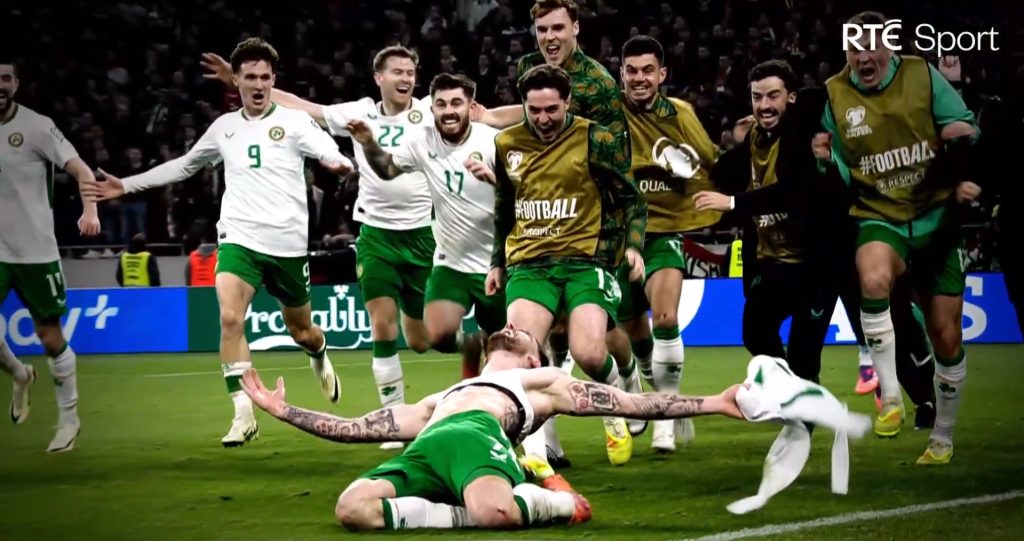
The heroics of Troy Parrott over the recent international break sent the country into pandemonium, and it would not surprise anyone if a statue of him appears on Sheriff Street before long. His winning moment in Budapest, with virtually the last kick of the ball, sealed his hat-trick and sent Ireland into the World Cup play-offs. In his post-match interview with Tony Kelly on RTÉ, Parrott spoke with pride about home, saying, “I love where I’m from.” It was a line that sent shivers down the spines of viewers as tears of joy streamed down his face.
More than 1.017 million people watched the moment live on RTÉ on Sunday 16 November. For brands who had secured advertising slots in advance, it was the kind of national reach that is rarely achieved. But the real surge happened online. The goal, the interview and the dressing-room celebrations have generated tens of millions of views across social platforms, proving yet again how fast sports moments travel and why they remain one of the most powerful cultural spaces for brands.
Mega sports events show this impact on a global scale. The FIFA World Cup 2022 reached an estimated 5 billion unique viewers, with revenues for the cycle totalling roughly €5.8 billion. Broadcasting rights accounted for around €3.4 billion, with sponsorships contributing more than €1.6 billion. These numbers highlight the commercial weight behind major tournaments. The global sports sponsorship market is expected to grow from approximately €90 billion in 2025 to around €173 billion by 2035, driven by the premium brands place on guaranteed mass attention.
For marketers, the opportunity is straightforward. Sponsorship activation around major events can increase brand impressions by up to 40 per cent, especially when supported by strong creative and timely social content. More importantly, these events reach people who would never identify as sports fans. They stop what they are doing, sit down with family or friends, and join the collective moment. For brands, that emotional alignment is priceless. It creates familiarity and positive association in a way ordinary campaigns cannot replicate.
Looking ahead to the FIFA World Cup 2026, the scale becomes even clearer. With more than 100 matches taking place across North and Central America, the cumulative global audience is expected to surpass previous tournaments. If Ireland qualify in March, the domestic audience alone could approach five million people, with online engagement multiplying that many times over. Even brands that assume football is not “their space” will be speaking to a nation tuned in.
This is where preparation matters. TV coverage, social content, real-time creative, sponsorships and competitions should all form part of a thoughtful, well-paced plan. The brands that succeed will be the ones who understand how to add value to the moment rather than distract from it.
Be ready, stay adaptable and let Marketing Network Group develop the strategy that puts your brand in the right place when the country comes together next summer.
Oh yeah, and Come on Ireland.
